
“The details are not the details. They make the design.”— Charles Eames
There is no single right answer to this question. Both Design and Design & Build can work well, but they suit different types of clients and projects.
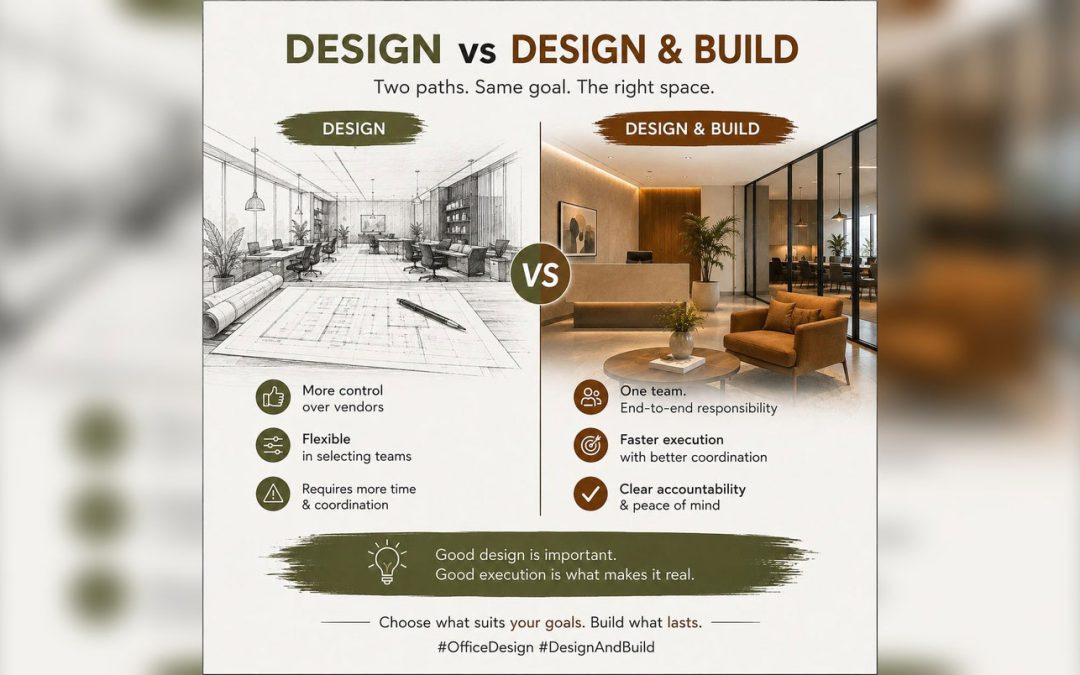
A design-only approach means the designer develops the concept and documentation, while the client appoints contractors and vendors to execute the work.
The biggest advantage is control. The client can compare contractors, negotiate individual packages and choose specialists independently. It can also work well for someone who has the time and experience to manage the execution.
The downside is coordination. The designer may not be responsible for what happens on site, so the client often becomes the link between the designer, contractor, suppliers and other consultants. Small gaps in communication can sometimes lead to delays, additional costs or differences between the design and the finished space.
Design & Build brings design and execution under one responsibility.
The obvious advantage is convenience. One team handles the transition from concept to drawings, procurement and execution. Changes can often be discussed and resolved faster because the design and execution teams are working together.
Accountability can also be clearer. If something goes wrong, there is one primary team responsible for addressing it.
But there are disadvantages too.
The client may have fewer opportunities to independently compare contractors and vendors. The initial quotation can also appear higher because it includes more services and responsibilities. Most importantly, the client needs to be comfortable with the Design & Build company they appoint.
Transparency therefore becomes extremely important.
Scope, materials, specifications, quantities, timelines, payment terms and exclusions should all be clearly documented before work begins.
Scope, materials, specifications, quantities, timelines, payment terms and exclusions should all be clearly documented before work begins.
That is not necessarily true.
A professionally managed Design & Build project should still involve the client in important decisions. The difference is that the client is not expected to coordinate every individual contractor and supplier.
Technology and AI are also changing both models. Designers can now develop concepts, test layouts and create visualisations much faster. Project teams can coordinate information more efficiently and identify certain problems earlier.
But neither technology nor a beautiful 3D render guarantees a successful project.
Execution still depends on people, communication, workmanship and attention to detail.
Mies van der Rohe famously said, “God is in the details.”
That remains relevant in interiors because the difference between an average project and an excellent one is often found in the details that are barely visible in a presentation.
So, which option makes more sense?
Design-only may be better for a client who wants greater control over contractors, enjoys being involved and has the time and knowledge to manage execution.
Design & Build may be better for someone who values convenience, coordination and having a single team responsible for taking the project from an idea to a finished space.
Neither model is inherently superior.
The right choice depends on the client’s priorities, project complexity, budget, timeline and willingness to be involved.
The most important thing is not choosing the bigger package.
It is choosing the model where responsibilities are clear, costs are transparent and expectations are realistic.
Good design is important.
Good execution is equally important.
And the best outcome usually comes when both are treated as part of the same conversation.