
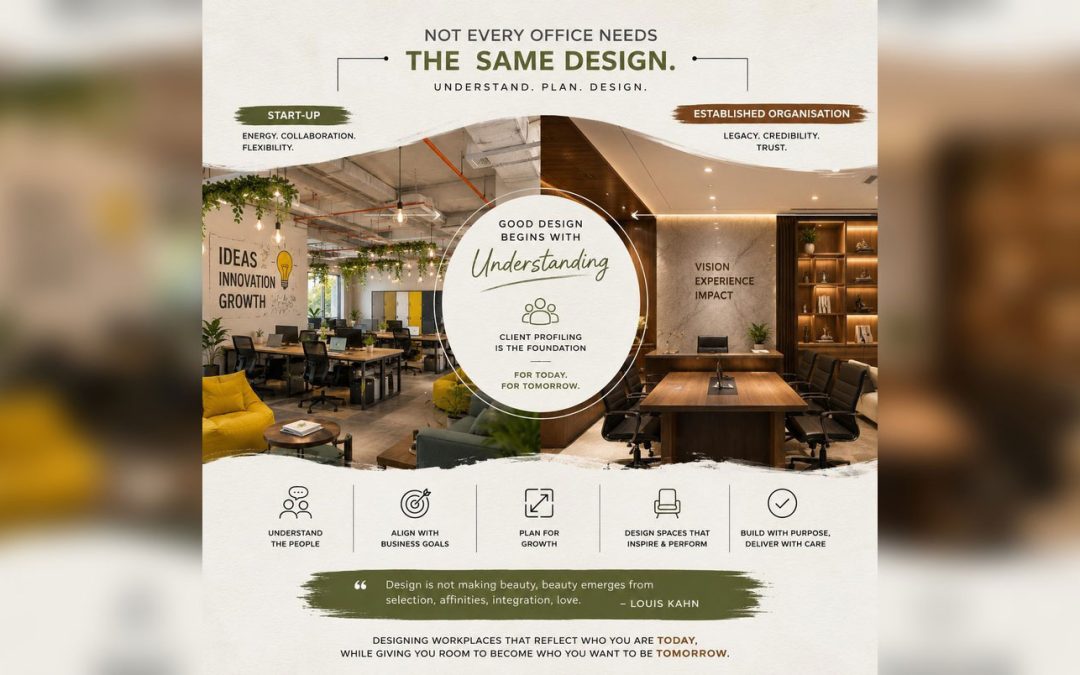
Walk into a young start-up and you may find energy, movement, colour and a certain informality. Walk into an organisation that has been around for decades and you may feel something completely different: stability, experience, confidence and a sense of legacy.
Neither is right or wrong. They simply need different design solutions.
This is where, as interior designers, we need to do more than simply design a nice-looking office. We need to understand the client.
I call this client profiling.
Before putting a pencil to paper, we need to understand the organisation, its people, its culture, how it works, how it receives visitors, what it wants to communicate and, importantly, where it wants to go.
A start-up may need a workplace that encourages collaboration, energy and quick decision-making. An established organisation may want its office to communicate trust, credibility and the journey it has travelled. A growing business may need flexibility because today’s 50 people could become 150 in a few years.
That last part is often overlooked.
An office should not be designed only for today’s headcount. Good planning should allow the business to grow without making the entire workplace redundant every few years. Future workstations, meeting rooms, storage, services and even circulation need to be considered before the first wall is built.
As the legendary architect Louis Kahn said, “Design is not making beauty, beauty emerges from selection, affinities, integration, love.”
I think that applies particularly well to corporate interiors.
The colours, furniture, lighting, materials, branding and spatial planning should not be selected independently. They need to come together to represent the organisation and the people who work there.
And then there is the practical side.
An office needs good acoustics, comfortable lighting, sensible air-conditioning, adequate storage, well-planned electrical points, technology infrastructure and spaces where people can both concentrate and collaborate. These are not glamorous parts of an interior photograph, but they are what make an office work.
AI and visualisation tools are now making the design process faster. We can test ideas, create alternatives and visualise spaces much earlier. That is useful, but it does not replace understanding the client.
Technology can help us design faster.
It cannot tell us what the organisation should feel like.
That still comes from conversations, observation and experience.
For me, good corporate interior design is therefore not about following the latest trend. It is about understanding who the client is today, what they have achieved, what they want to become and creating a workplace that can travel that journey with them.
Because a truly successful office should not just look good on the day it opens.
It should still make sense when the business has grown, changed and become something bigger.