
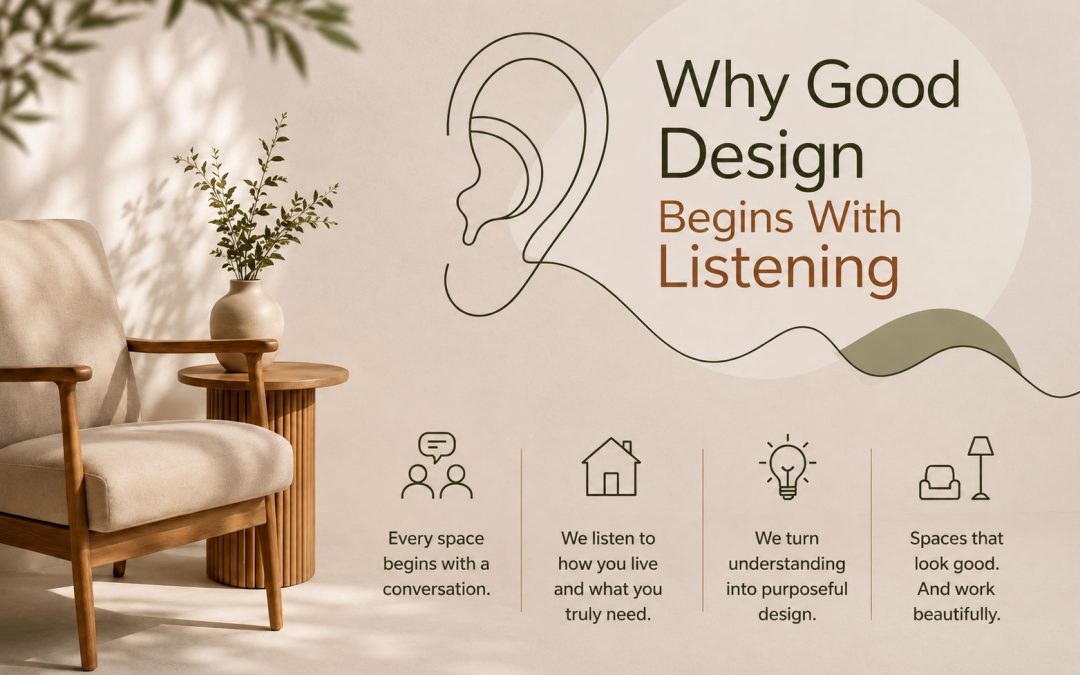
“Listening is perhaps the most important part of designing, and often the most difficult. As designers, we naturally want to bring our ideas, our thinking and our style to the table. But the real challenge is to step back, understand the person, and design a space that reflects them — not us.”- Sandeep Kaul, Founder, CRAFTSMEN
Over the years, I have learnt that the best designs do not begin with a pencil drawing/AutoCAD, Sketchup or any other software. They begin with a conversation.
When a client comes to us, they usually have a rough idea of what they want. Sometimes they have photographs saved on their phone, sometimes they know the colour they like, and sometimes they simply say, “I want something different.” Our job is not to immediately start designing. Our job is to listen.
When a client comes to us, they usually have a rough idea of what they want. Sometimes they have photographs saved on their phone, sometimes they know the colour they like, and sometimes they simply say, “I want something different.” Our job is not to immediately start designing. Our job is to listen.
These things may not sound like design decisions, but they are.
A beautiful wardrobe that does not hold enough clothes is poor design. A stunning office where people cannot collaborate comfortably is poor design. A restaurant that looks fantastic but has an inefficient service flow is also poor design.
Good design solves real problems.
As a founder, I have also learnt that listening means being willing to disagree. Sometimes a client asks for something that may not work practically. It is our responsibility to explain why, offer an alternative and find a solution that respects the original intention.
Technology, visualisation and AI have made the design process much faster. We can explore ideas, create visuals and make changes in a fraction of the time it once took. But none of these tools can replace understanding the person for whom we are designing.
That still comes from a conversation.
At CRAFTSMEN, our approach is simple: understand first, design second and execute with clarity.
Because when a space is designed around how people actually live and work, good design becomes much more than something that looks nice.
It becomes something that works.